The best time to visit Haleakala for sunrise
The best time to visit Haleakala depends less on the month than you might think. The sun rises over the summit every morning of the year and the tours run in every season. What changes is the hour your alarm goes off, how cold the rim feels when you get there and how many people share the railing.
The best time to visit Haleakala, in short
For a sunrise visit, the best time is a clear morning early in your trip, and no calendar can promise one of those. Within that, a few patterns help you pick your dates.
- Months with milder dawns: May, June, September and October, with a little less rain than winter and fewer visitors than the summer holidays
- Time of day: at the rim 30 to 60 minutes before sunrise, when the sky behind the cloud sea turns orange
- Point in your trip: the first two or three days, with a spare morning later in case the summit is clouded in
- Weeks to avoid if you can: the Christmas and New Year holidays and midsummer, when reservations and tour seats sell out first
The sections below explain each one, from pickup times to cold and crowds.
Sunrise times at Haleakala through the year
Maui sits in the tropics, so the length of the day changes far less than it does on the mainland. At the summit the sun comes up at about 5:40 am in June and about 7 am in January, with the other months in between. Hawaii does not use daylight saving time, so the clock never jumps, and the time drifts by only a few minutes from one week to the next.
That means no month is closed and no month is a sure thing. The choice is about trade-offs, mostly between an earlier alarm in summer and a colder, wetter wait in winter. The summit of Haleakala, Puʻu ʻUlaʻula at 10,023 ft (3,055 m), sees the same seasons as the beach, only far colder.
What time of day to go, and when tours pick up
The tours start the drive up hours before sunrise, so pickups move with the season. Skyline Hawaii, from ~$236, publishes its windows by month, and Polynesian Adventure Tours, from ~$236, uses two start times a year.
| Months | Skyline pickup | Polynesian start | Summit sunrise |
|---|---|---|---|
| April to September | 1:50–2:20 am | 2 am | Earliest, about 5:40 am in June |
| March, October, November | 2:20–2:50 am | 2:30 am | In between |
| December to February | 2:50–3:20 am | 2:30 am | Latest, about 7 am in January |
The colors start well before the sun itself, often half an hour ahead, so every tour aims to have you at the rim with time to spare. That means a wait in the cold, sometimes an hour or more, which matters more in January than in June. Winter does have one advantage for the tired. Because sunrise comes later, so does the pickup, and a 3 am knock on the door is easier than one before 2 am.
Polynesian sends the exact pickup two days before, and Skyline asks you to email at least 72 hours ahead to confirm yours. Reviewers of Valley Isle Excursions, from ~$264, report pickups around 2–2:50 am. The Bike Maui mornings check in at about 3 am at the Haiku shop all year, which from West Maui means leaving the hotel at 1 or 2 am.
Haleakala weather at dawn, season by season
A typical summit dawn falls between the low 30s and the upper 40s °F (about −1 to 9 °C), roughly 30 °F (17 °C) colder than the coast you left. Wind makes it feel well below freezing, and frost can form in any month. Winter mornings are the coldest and wettest, with more chance of a storm closing in. Summer is a little milder, but only a little, so pack the same layers in July as in January. Dressing for a freezing summit covers what to bring.
Clouds below and clouds on top
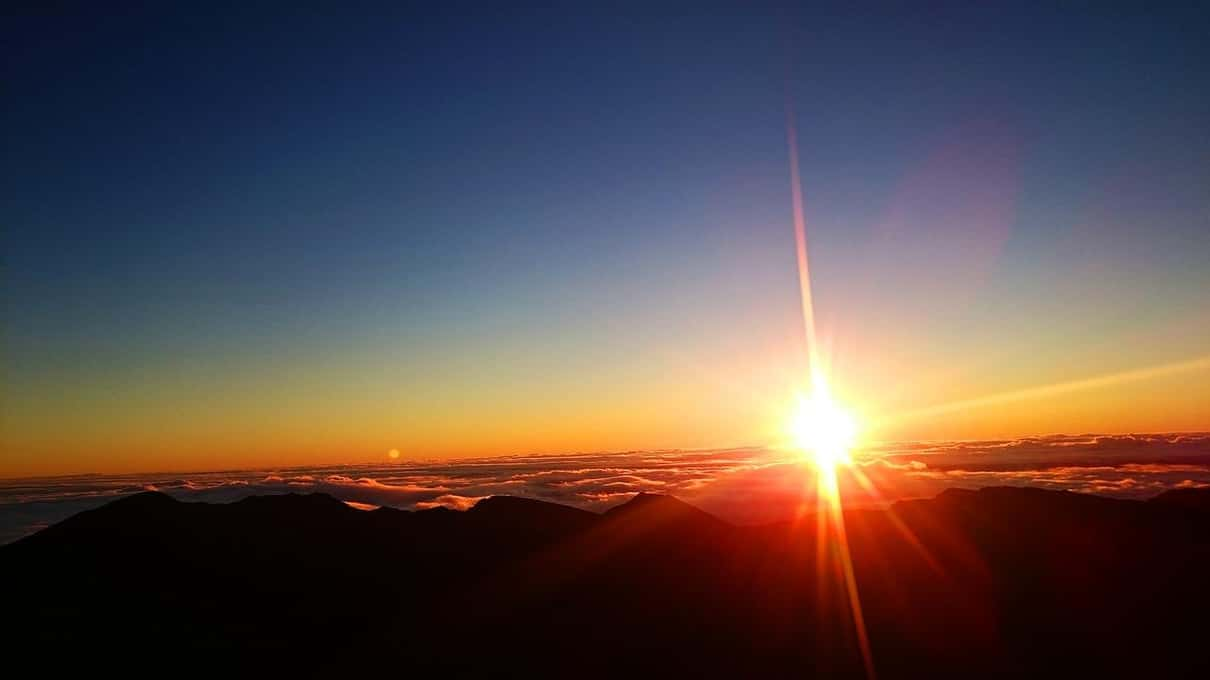
On most mornings a layer of cloud forms below the summit, held down by the trade-wind inversion, and that is the sea of cloud the sun rises out of. The summit itself is another matter. It can be wrapped in fog or rain while the coast is clear, and no forecast is reliable a day out. The operators run rain or shine, and none of them refunds for a grey sunrise, so a clouded-in morning is part of the gamble in every month.
Some visitors go up a second time for that reason. If you only get one try, keep your expectations loose and stay for the crater once the light comes. Photographing sunrise above the clouds helps with the shots in either kind of weather.
The busiest times to visit
Summer and the holidays bring the most visitors, and in those weeks the private-vehicle reservations go fastest, sometimes within minutes of release. Tour seats can fill in those weeks too. If your trip lands in a busy stretch, book the tour or the sunrise reservation as soon as your dates are firm. The rim is rarely empty at dawn in any month, so expect company at the railing whenever you come.
Pickup windows set by the month
Skyline Hawaii collects you from your hotel or condo at a time fixed by the season, from ~$236. Email the operator 72 hours ahead to confirm, and cancel free until 48 hours before.
When in your Maui trip to go up
Visitors from the mainland have one advantage in the first days of a trip. Jet lag pulls the body clock earlier, so a 2 am alarm feels less brutal on night two than on night eight. Put the sunrise near the start of your stay and keep a later morning free as a backup, in case the summit is clouded in or a pickup goes wrong. With 24 hours' free cancellation on most tours (48 on Skyline), you can still move it if the week changes.
Plan the rest of that day around a nap. Most sunrise tours are back by late morning, and the afternoon is often lost to sleep. What to do after sunrise suggests how to spend the hours before it, and drive yourself or join a tour helps if you are deciding who should be awake at the wheel.
The moon and stars on the way up
The early start has a reward before dawn. On a moonless morning the Milky Way spreads across the sky above the summit, one of the clearest night skies anywhere, which is why the Haleakalā Observatory sits just past the top. Several reviewers recall a stop on the climb to look up at the stars. A bright moon washes out the faint stars but lights the crater and the cloud tops, which has its own appeal. If the stars matter more to you than the sunrise, read our guide to sunset and stargazing before you book.